Guild History
Origins
Background
During the reign of Queen Elizabeth I, Sunday was a day on which all manner of sports were played. Bell ringing for pleasure was permitted, but only one bell was to be used as a summons to attend services. From this time on bell ringing became a secular sport, with very little connection with the building in which bells were hung. Probably the survival of bell ringing was actually because it was regarded as a secular sport.
Companies of bell ringers with rules somewhat similar to those of the livery companies were established. The oldest of these companies which still exists is that of Lincoln Cathedral, the Ordinances of which date from 1612. The London-based Ancient Society of College Youths dates from 1637.
Bell ringers became noted for their unruly behaviour — in 1808 the Chapter Acts of Lincoln Cathedral record that the ringers were disorderly and noted for their drunkenness.
19th Century
Belfry Reform
By the mid-nineteenth century the influence of the Oxford Movement led to belfry reform, and a number of territorial ringing societies were established with the main object of encouraging bell ringing as a service to the church.
The South Lincolnshire Association was founded on 12 August 1879, and five years later on 4 October 1884 the East Lincolnshire Association was founded. Also in 1884 the Eastern Counties Association was founded, as was the North Lincolnshire Association.
When the Central Council of Church Bell Ringers was founded in 1889 its object was "to promote and foster the ringing of bells for Christian Worship and celebration…". All the above Associations were affiliated to the Council, with the exception of the East Lincolnshire Association.
1899
The Founding of the Guild
In 1899, mainly through the influence of Revd H. Law James, it was agreed that the four Associations should be combined to form the Lincoln Diocesan Guild of Church Bell Ringers. The first meeting of the Diocesan Guild was held on Saturday 29 April 1899 with the Bishop of Lincoln in the chair. It was agreed that the objects of the Guild were to be: to encourage the recognition of ringers as church workers; to promote the ringing of bells for worship and on other suitable occasions; to promote the repair and restoration of bells; to recruit and train ringers; and to promote and advance change ringing.
The Annual Meeting of the Guild is held on the last Saturday in April in Lincoln. The Bishop of Lincoln has been Patron for the whole period of the Guild's existence.
The first Master of the Guild was Revd Henry Law James of Surfleet, who was a well respected although in some ways controversial bell ringer. There is no doubt that the credit for the success of the Guild in its first 25 years was due to him.
A Guild Membership Certificate was designed by Mr F. F. Linley of Gainsborough, with many similarities to the one he had designed for the North Lincolnshire Association in 1890. The first batch of certificates was presented to the Guild by the Northern Branch in 1904.
Law James was forthright in his published comments. In 1905 he wrote "Let me say it again, as I have said before, Lincolnshire striking is poor…" and in 1910 "The striking in the southern portion of the county is steadily improving, owing to wider leading, and I hope that North Lincolnshire will follow suit, as ringing without open leads is not fit to listen to…".
The Guild's first peal of Cambridge Surprise Minor was rung in 1909, and the first in seven Minor methods was rung the following year. Both these peals were rung at Edenham. The Guild's first peal of Surprise Major was — perhaps surprisingly — by a non-resident band, ringing Superlative on handbells. Within a month Law James called a peal of Cambridge Surprise Major at Spalding by a resident band.
1914–1932
World War I and After
Many ringers were lost during the war and as a result of the influenza outbreak of 1918–19. Only 28 peals were rung for the Guild in the first full year after the war. However, two noteworthy peals were rung at Surfleet — Surfleet Double Court Royal and Double Norwich Court Bob Royal, both composed and conducted by Law James.
John Ashley Freeman of Lincoln became the first ringing master of the Northern Branch in 1922, a position he held for 25 years. He called the first peal of London Surprise Major for the Guild in 1928. Sidney Proctor of Grantham called peals of Stedman and two Surprise Minor bands emerged in the Southern Branch.
In 1924 the ringing career of Jack Bray commenced, and from 1926 he became the leading organiser of ringing in the north of the county both on tower and handbells. In 1928 a band drawn largely from Gainsborough rang the first peal of Spliced Major for the Guild — Little and Plain Bob Major.
The Elloe Deaneries were by far the strongest region of the Guild. During the 1920s, the Richardsons invited many of the leading ringers in the country for a ringing holiday based at their home in Surfleet. Many peals were rung during these weeks, some in unusual places — including a blacksmith's shop in Long Bennington, Surfleet cricket ground, a rowing boat on the River Glen, the fuselage of a Handley Page bomber at Cranwell, and on the sands at Skegness.
Although the eight bells at Lincoln Cathedral had been recast in 1913 and hung in a new frame soon afterwards, the western towers were found to be unsafe and ringing was stopped. However, after a major restoration, four treble bells were cast and Lincolnshire's first ring of 12 bells was opened on 15 December 1928. Two of these new bells were paid for by members of the Guild as a memorial to those ringers who had died during the war, and two by an anonymous American. The first peal on the new 12 was Cambridge Surprise Maximus, rung on 23 December 1929 by a resident band with Law James as conductor.
In 1932 Revd Henry Law James died at the age of 63. Over 600 people attended his funeral, confirming the esteem in which he was held throughout the country. Rupert Richardson was elected Guild Master — a physically large and ebullient character who had been involved in all of the "firsts" for the Guild.
1939–1945
World War II
After the outbreak of war in 1939, peal ringing decreased; other ringing continued until 1940, when bell ringing was only to take place as a warning of invasion. After this some meetings were arranged for handbell ringing and other social activities, but after a time the clappers were removed from most bells and silent "ringing" was resumed.
A suggestion in the Ringing World that ringers should give hospitality to ringers in the Forces or on other war work resulted in the Guild Master, Rupert Richardson, declaring his farm "open house" — he even managed to get an extra allocation of petrol so that he could attend Guild Meetings.
As a celebration of the victory of El Alamein in November 1942, bells were rung open. Ringing was also allowed on Christmas Day the same year, and on 25 April 1943 the ban was lifted for service ringing. In June it was agreed that all restrictions should be lifted.
Nine Lincolnshire ringers gave their lives during the war, but only Waddington church was destroyed by enemy action. Amazingly the bells survived.
1945–1959
The Post-War Revival
As ringers slowly returned home after war service, ringing began to return to normal. 90 peals were rung in the first year after the war, but on 13 January 1947 Rupert Richardson died. At his funeral all the leading ringers in the country attended, and in his memory a bell was added to the 12 to make a light eight. Rupert's successor as Guild Master was John A. Freeman.
The six-bell handbell peal band led by George Feirn began 1947 with a record peal in 53 methods, reaching 105 methods by June. In March 1947 the pre-war Spliced Surprise Major band conducted by John A. Freeman established a new record with 16 methods. A band then set a new record length of 14,144 changes of London Surprise Major, rung on 4 October 1947 in 8 hours 25 minutes — a record that stood for over 30 years.
In 1949 a band based at Frampton in the Eastern Branch rang peals in 26, 32 and 33 Spliced Surprise Minor. After a break of four years they rang one in 35 methods, and on 5 March 1955 rang 38 methods — a record at the time, conducted by Rhoda Brown (later Rhoda Reynolds).
The Central Council of Church Bell Ringers chose Lincoln again for its meeting in 1952. John A. Freeman died in January 1961, having been Master since 1947. In his memory the Branches subscribed towards a Master's Badge of Office.
1960s & 70s
The 1960s and 70s
The new Master was Jack Bray. In the 1960s two peal bands became very active — the "Monday-night" band from the Spalding area led by Ron Noon, and a mainly Lincoln band under Jack Millhouse.
In 1963 the first Guild Festival was held, taking the form of a cricket match with north playing south. The same year Jack Millhouse became the first Guild member to ring 1000 peals. In 1965 the highest number of peals yet rung for the Guild was 194, with 42 conductors.
In 1969 the first Guild Striking Competition took place on the six bells at Branston — an annual event ever since, with finalists from the six branch striking competitions taking part in the final.
In the 1960s residential bell ringing courses began to be part of the ringing year. Harold Radley arranged the first in Lincolnshire at Brant Broughton in 1967, attended by 32 students, with follow-up half-day courses held across the county.
At the 1979 Guild AGM a proposal to double peal fees was withdrawn after warnings of its consequences, but raised again the following year and agreed. The result was the formation of The South Lincolnshire Society. After a meeting in 1983 between the two sides, peal fees were set at a more reasonable level and the South Lincolnshire Association was disbanded with effect from 1 January 1984.
The Central Council of Church Bell Ringers visited Lincoln for a third time for its 1975 meeting — a much bigger event than the two previous meetings, attended by representatives from across the country.
1980s & 90s
The 1980s and 90s
The 1980s were notable for the sheer number of peals rung — 217 in 1983, 210 in 1984 and 219 in 1985. Jack Millhouse in 1984 became Lincolnshire's first 2000-peal ringer and also recorded 1000 peals as conductor.
John Walden, who died in 1986 at the age of 94, rang in many notable peals since the 1920s — he rang peals of Stedman Triples on the "Richardson Eight" on his 90th, 91st and 92nd birthdays.
In 1985 Michael Stracey began the task of collating and analysing quarter peals rung in the Diocese, a task which he undertook for many years, even when posted to Germany with the RAF.
John Freeman died suddenly in 1989. He had held branch offices in the Guild and was Guild Secretary before becoming Guild Master. He was Vice President of the Central Council, then President for six years, following which he was made a life member.
Although a memorial to those ringers who had lost their lives in the First World War was in the Ringers' Chapel at the Cathedral, it was not until 1997 that this was replaced with a new memorial commemorating those ringers who had lost their lives during both World Wars.
1999 was the Guild Centenary year and the Central Council visited Lincoln for a fourth time. A Centenary Dinner was held in the Summer of 1999, somewhat saddened by the death of Jack L. Millhouse in the previous week.
2000–Present
The Millennium and Beyond
The impending Millennium encouraged a recruiting and teaching campaign which resulted in a number of new ringers, particularly in the older age groups. A remarkable number of bell restorations took place both before and after the year 2000, with many resulting in completely new rings of bells across the county.
The eight at Market Rasen were restored after a silence of many years, and Harrington and Claypole were rehung. New rings were hung at Middle Rasen, Sutton St James, Bottesford, Thorpe on the Hill, and augmentations were carried out at Gunby (3 to 5) and Tealby (4 to 6).
2003 was a particularly busy year with the National Twelve Bell Striking Competition Finals taking place at Surfleet, and The Ringing Roadshow at the Lincolnshire Showground — both major events in the ringing calendar that were enjoyed by ringers from across the country.
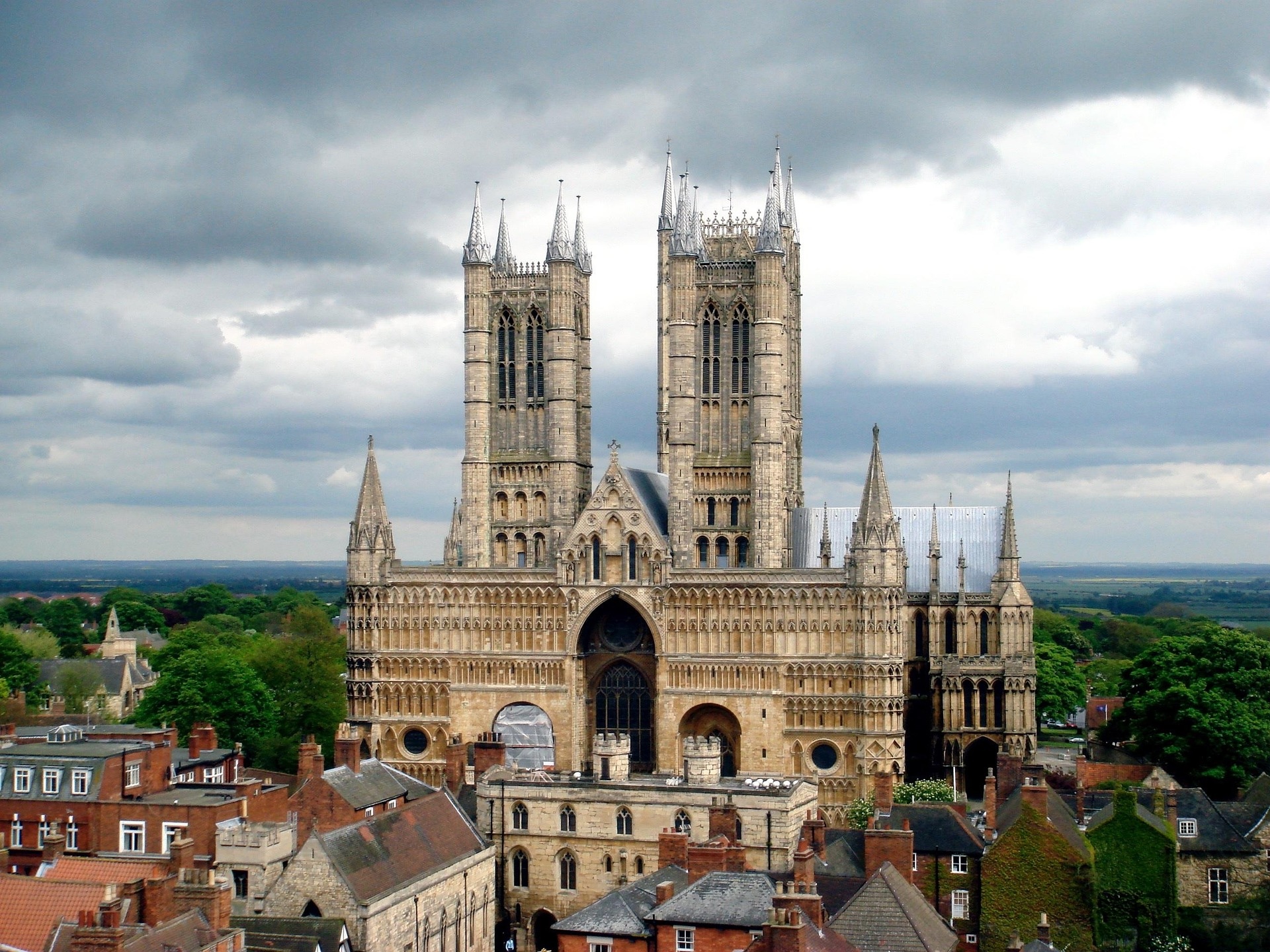
The territory covered by the Guild is the Anglican Diocese of Lincoln, comprising the whole of Lincolnshire as it was before the 1974 boundary revision. Most of the county's 600 fine churches are mediæval, and the jewel in Lincolnshire's crown is undoubtedly Lincoln Cathedral. About 270 of our churches have bells hung for full-circle ringing, and there has been a great deal of re-hanging and augmentation in recent years.
Now named the Lincoln Diocesan Guild of Church Bell Ringers and celebrating over 125 years of ringing, the Guild continues to serve the churches and communities of Lincolnshire — recruiting, training, and ringing for worship and celebration across the county.